Tips & Nozzles Guide
Standard Nozzle Spray Patterns & Uses
0°
Red
|
15°
Yellow
|
25°
Green
|
40°
White
|
65°
Black
|
|---|---|---|---|---|
|
Uses: A powerful and concentrated jet, capable of removing stubborn stains on hard surfaces. |
Uses: Acts like a scraper, ideal for heavy duty cleaning and paint stripping on hard surfaces. |
Uses: For general cleaning projects such as patios and driveways. |
Uses: Large spray can clean large areas fast. Good for easily damaged surfaces. |
Uses: Combines water with cleaning detergent. |
|
Surfaces Use Extreme Caution: Can damage most surfaces, including metal and concrete, if used incorrectly. Do not use on wood. |
Surfaces Driveways, metal grills, concrete or brick walkways. Can damage wood and soft surfaces. |
Surfaces Patios and driveways, such as block paving and concrete along with metal furniture. |
Surfaces If you are unsure on what to use, start here and work up. Safe for most surfaces including wood, windows and vehicles. |
Surfaces Ideal for applying chemicals and downstreaming. Suitable for most surfaces. |
Standard nozzles are the nozzles that will generally come packaged with any store bought or online bought pressure washer. They feature a 1/4″ male quick connect on the back and are designed to work with almost all wands. These nozzles are great for getting started. The only downside of these nozzles is that they are all separate pieces, making them difficult to carry on the job site, easy to lose, and a chore to alternate while working.
Specialty Nozzles
JROD
|
2nd Story Nozzles
|
Shooter Tips
|
Twist Nozzle
|
Turbo Nozzles
|
|---|---|---|---|---|
| Not technically a nozzle, but a handy holder that mounts multiple nozzles (typically 4) for quick switching during jobs without changing tips manually. | A pack usually including two nozzles: one optimized for applying soap at a distance and another for rinsing, ideal for cleaning upper levels of buildings without ladders. | Enhanced nozzles designed to project water streams farther to reach high areas, offering better performance and control compared to standard 2nd story nozzles. | An adjustable nozzle that lets you vary the spray pattern (from narrow to wide) simply by twisting the head—versatile and convenient. (A personal favorite for its ease of use!) | Rotating nozzles that spin at high RPM to create a powerful, wide cleaning path, covering large areas quickly. Often include an in-line filter to prevent clogs from debris. |
| Buy on Amazon | Buy on Amazon | Buy on Amazon | Buy on Amazon | Buy on Amazon |
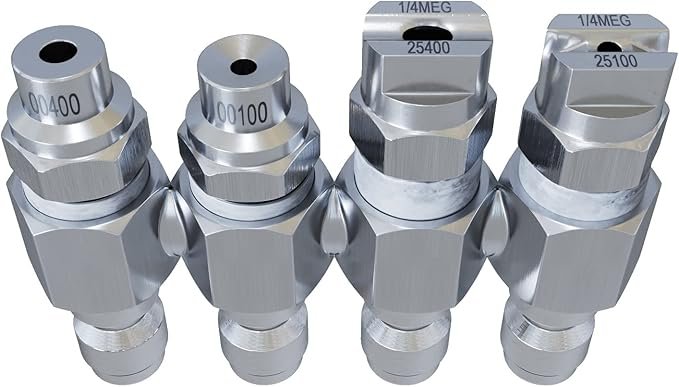
Once you’ve got a few house washes or driveway cleaning’s under your belt, it’s time to dive deeper into the world of nozzles. Specialty nozzles exist for a specific application, and there’s way more out there than the ones listed here. After washing hundreds of houses, we recommend a twist nozzle for house washing. Being able to quickly adjust the spray pattern without removing the nozzle is ideal and will save you a lot of time. Although you can get decent distance out of the twist nozzle, you’ll want to order either a second story nozzle or a shooter tip to use in conjunction with the twist. The ultimate solution is mounting a twist and shooter tip on the same JROD. It’s probably the most commonly used nozzle combo in the whole industry.
While you’ll rarely use turbo nozzles for basic house or concrete cleaning, they’re also a good tool to have in the arsenal. We find them especially useful for cleaning large sections of stairs, stripping paint from metal surfaces and cleaning retaining walls.
How To Size Pressure Washing Tips
This video provides a detailed explanation on how to properly size surface cleaner tips using sizing charts. It covers essential aspects such as orifice size, spray angle, and matching them to your pressure washer's PSI and GPM for optimal performance.
OR, for an easier method, use the calculators that we built below.
Pressure Washer Nozzle Calculators
Single Nozzle Calculator
Enter your pump's flow rate in GPM and the desired pressure in PSI to calculate the required nozzle orifice size.
Surface Cleaner Nozzle Calculator
Enter your pump's flow rate in GPM, the desired pressure in PSI, and the number of nozzles on your surface cleaner to calculate the required nozzle orifice size.
We recommend sizing your surface cleaner tips for around 2500 psi. Cleaning at pressures above 3000 psi can greatly increase the likelihood of etching the concrete.
Nerd Tip: A 25 degree (green tip) nozzle will most commonly be used with your wand to clean the edges around the surface cleaning areas. It’s a good idea to size your green tip nozzle for the same pressure as your surface cleaner to give a consistent clean result.